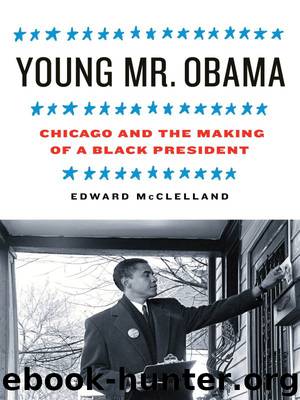
Young Mr. Obama by Edward McClelland
Author:Edward McClelland
Language: eng
Format: epub, mobi
Publisher: Bloomsbury Publishing Plc
Published: 2010-06-20T16:00:00+00:00
Chapter 9
DEFEAT
W H I L E O B A M A ’ S P A T H T O P O W E R had gone through Columbia and Harvard, Bobby Lee Rush learned politics on the streets. Rush’s entire life had been a series of escapes from the fates that destroyed so many black men of his generation. He was born in rural Georgia to parents who were too proud to endure segregation. They moved the family to Chicago when Rush was a young boy. At seventeen, he dropped out of his inner-city high school to join the army but went AWOL during the Vietnam War to help found the Illinois Black Panther Party.
As the Black Panthers’ deputy minister of defense, Rush was the sole survivor of the party’s ruling triumvirate. His compatriots, Mark Clark and Fred Hampton, were gunned down by the police in the 1969 raid that catalyzed the black political rebellion against the Machine. A photo of Rush wearing a fur hat and wielding a long-barreled pistol became one of the best-known images of 1960s militance in Chicago.
Rush left his radical past behind to earn two masters’ degrees, become an ordained Baptist minister, and win election as an alderman, standing with Harold Washington against the Twenty-nine, who tried to maintain white control of the city council. All along, he saw himself as an underdog, bent on self-improvement. Describing Rush as a boy, his father told him, “You wanted to read so bad and study so much that you said you wanted to die in a classroom.” As a man, he was a disciple of motivational guru Tony Robbins, who urged his listeners to “awaken the giant within.” Rush was a hero of the civil rights movement, the black power movement, and the Washington years, and he was proof that a black man could succeed. You couldn’t out-ghetto Bobby Rush in Chicago.
Obama didn’t intend to try. He didn’t think he’d have to. In that disastrous run for mayor, Rush even lost his own ward, which hadn’t voted for a white candidate since before Harold Washington. To many, the election was a sign that Daley had finally brought an end to “Beirut on the Lake”—the city’s black vs. white political wars—and that Rush’s style of racial confrontation had had its day.
The First District is a bellwether of black politics, not only in Chicago, but in the nation. Rush had won the seat by unhorsing Representative Charles Hayes, an elderly veteran of Martin Luther King’s voter registration drives. Obama thought the district was ready for another generational change, to a postracial politician who could reach out to whites.
Plus, for an old firebrand, Rush was a surprisingly bland figure. He had worked hard to overcome a childhood stutter, and while he spoke fluidly, he rarely raised his voice on the stump. To Obama, Rush was an uninspiring, ineffectual congressman who had ridden to Washington, D.C., on his public image and was now doing little for his district. But fighting on his home turf—the South Side—Rush turned out to be wilier and more potent than Obama expected.
Download
This site does not store any files on its server. We only index and link to content provided by other sites. Please contact the content providers to delete copyright contents if any and email us, we'll remove relevant links or contents immediately.
Fanny Burney by Claire Harman(26607)
Empire of the Sikhs by Patwant Singh(23090)
Out of India by Michael Foss(16861)
Leonardo da Vinci by Walter Isaacson(13341)
Small Great Things by Jodi Picoult(7156)
The Six Wives Of Henry VIII (WOMEN IN HISTORY) by Fraser Antonia(5519)
The Wind in My Hair by Masih Alinejad(5103)
A Higher Loyalty: Truth, Lies, and Leadership by James Comey(4967)
The Crown by Robert Lacey(4821)
The Lonely City by Olivia Laing(4808)
Millionaire: The Philanderer, Gambler, and Duelist Who Invented Modern Finance by Janet Gleeson(4482)
The Iron Duke by The Iron Duke(4367)
Papillon (English) by Henri Charrière(4278)
Sticky Fingers by Joe Hagan(4207)
Joan of Arc by Mary Gordon(4117)
Alive: The Story of the Andes Survivors by Piers Paul Read(4037)
Stalin by Stephen Kotkin(3973)
Aleister Crowley: The Biography by Tobias Churton(3646)
Ants Among Elephants by Sujatha Gidla(3470)
